2026-11-29
Gangnam Facelift: Check This First, Not Just Your Age
Age alone doesn't determine whether a Gangnam facelift suits you. Here's how sagging stage, skin elasticity, and the difference between facelift and mini facelift help you decide.

“I hesitated because of my age, but age wasn’t the problem — my most satisfying choice!” With before/after jawline profiles.
When researching facelifts in Gangnam, two concerns almost always come up: “Is it the right time for someone my age?” and “Should I choose a facelift or a mini facelift?”
In truth, these two questions are best answered together rather than separately. Today, we’ll go over everything from age guidelines to the differences between the two procedures.
Is it too early in your 40s, or too late in your 60s?
Facelifts are commonly reported to achieve the highest satisfaction in the late 40s to early 60s. Sagging is clearly visible by then, yet the skin still retains a good amount of elasticity, so the results after lifting tend to be easy to see.
That said, there’s one thing we don’t want you to misunderstand: this is a general trend, not an age requirement.
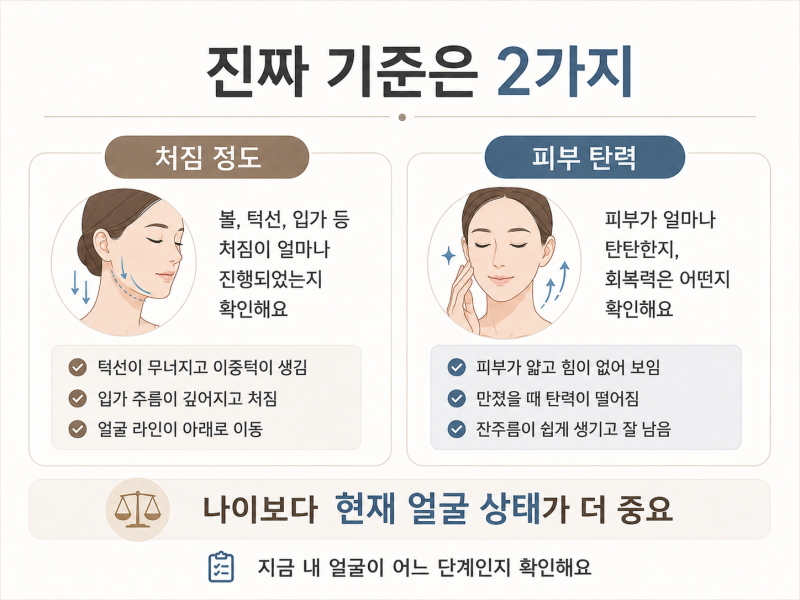
The two real criteria: degree of sagging and skin elasticity. Your current facial condition matters more than your age.
Some people in their 50s have almost no sagging, while some people in their 40s already have significant loss of volume in the cheeks and definition along the neck. Likewise, someone in their 70s may be a candidate for surgery if their underlying conditions are well managed and they pass anesthesia screening.
For people in their 20s and 30s, surgery is only considered in limited cases, typically when there is a structural cause, such as sagging after contouring surgery or rapid weight changes, rather than age-related sagging. If a clinic strongly recommends a lift for someone in this age group without a clear reason, be cautious.
Ultimately, what matters more than age is how far your facial sagging has progressed and how much skin elasticity you still have.
So what’s the real standard?
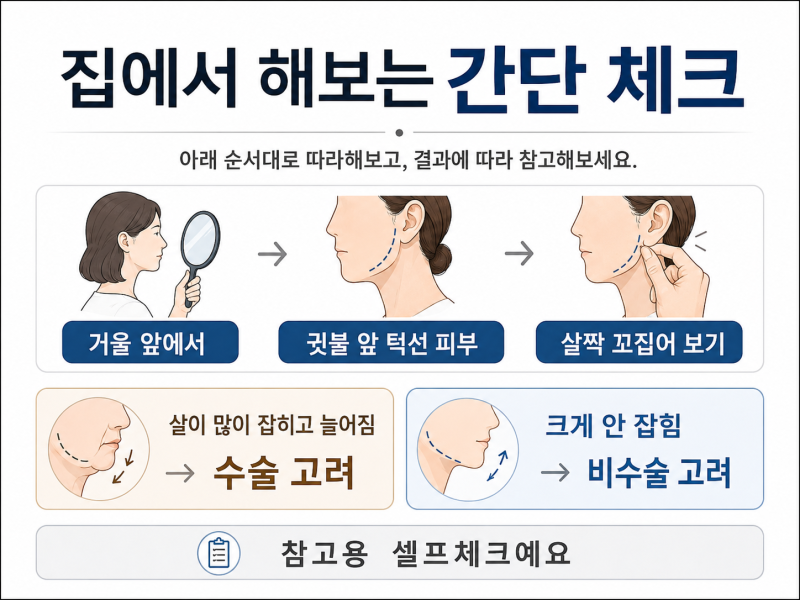
Home self-check: pinch the jawline skin in front of the ear. Lots of loose skin → consider surgery; little → non-surgical. Reference only.
There’s one simple method you can try at home. In front of a mirror, gently pinch the skin along your jawline, just in front of your earlobe.
If you can grab a lot of tissue and it feels clearly loose and drooping, a facelift may help improve it. If not, a non-surgical lifting treatment may be a better fit.
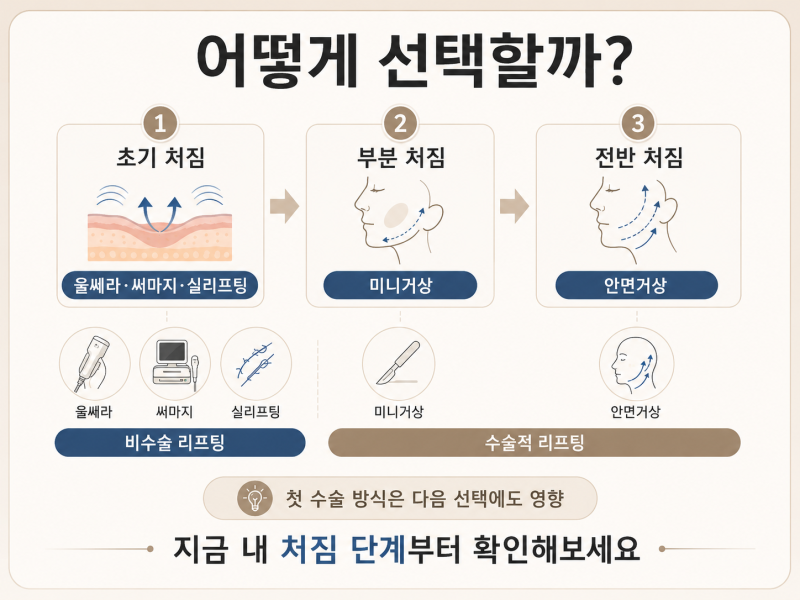
Choosing by stage: early sagging → Ulthera, Thermage, thread lift; partial → mini lift; overall → facelift. The first choice affects later ones.
Of course, this is only a simple reference. It’s hard to judge the condition of the SMAS layer (the fascial layer beneath the skin) by eye, and skin condition can vary from area to area even in the same person. For an accurate assessment, it’s best to get evaluated by a specialist.
What’s the difference between a facelift and a mini facelift?
If surgery is deemed necessary, the next question is whether a facelift or a mini facelift is the right fit.
Both procedures involve making incisions in the skin and directly lifting the SMAS layer. The difference lies in the extent of the incisions and how far the tissue is separated.
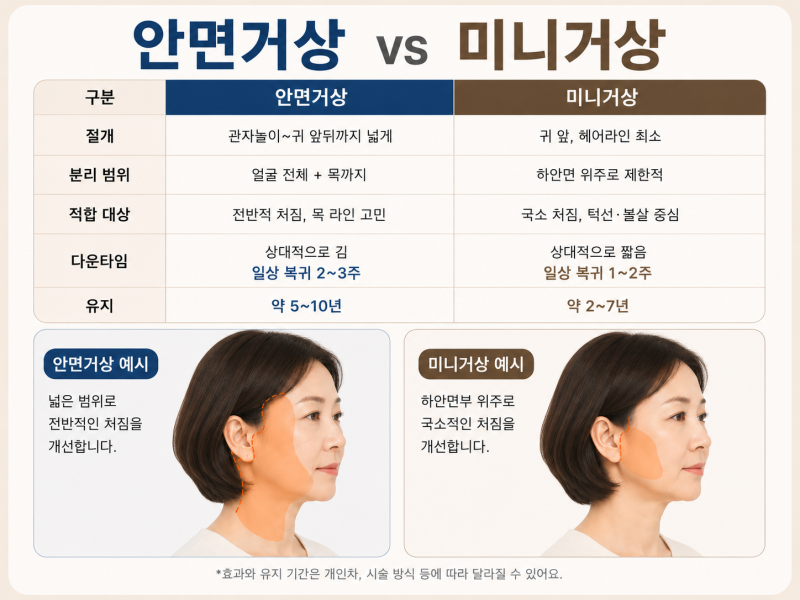
Facelift vs mini lift: incision, area, candidates, return to routine (2–3 vs 1–2 weeks) and longevity (about 5–10 vs 2–7 years).
A mini facelift uses smaller, partial incisions and mainly corrects the cheeks and jawline. It’s a suitable choice when sagging is concentrated in certain areas or hasn’t progressed much into the neck.
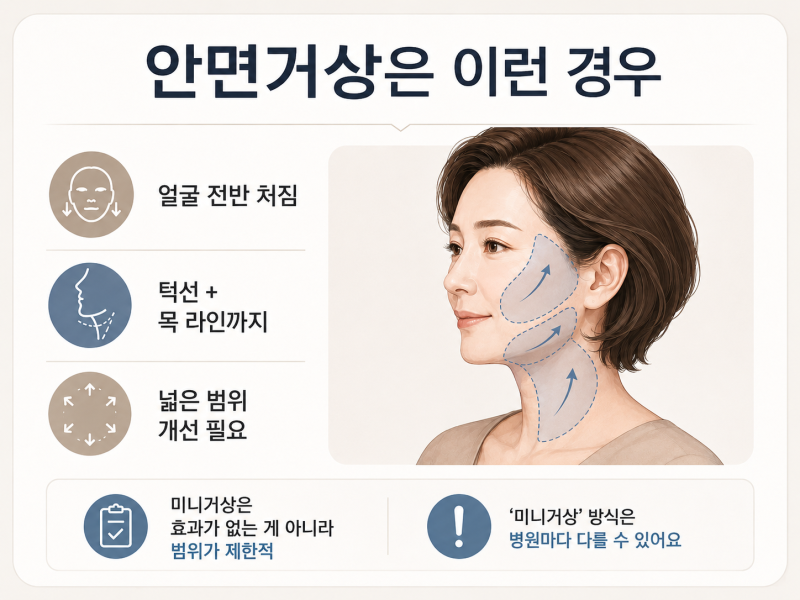
A facelift suits overall facial sagging, jawline plus neck, and wide-area needs. A mini lift isn’t ineffective, just limited in range.
A facelift uses a wider incision that covers the cheeks, jawline, and neck. When sagging has progressed across the face as a whole, it can deliver substantial results.
When you look at facelift before-and-after photos, paying attention to this difference in incision range will help you see how the two procedures differ more clearly.
You’ve probably heard the claim that “mini facelifts don’t work.”

A mini lift suits sagging mainly in the cheeks and jawline, little neck sagging, or partial correction — when sagging is limited.
It’s less that mini facelifts don’t work and more that the scope of improvement is limited by the technique. If you choose a mini facelift when sagging extends across the face and neck, the areas that weren’t lifted will remain loose, which can leave you less satisfied.
On the other hand, for those whose sagging is limited to a specific area, it can be a very good choice.
Keep in mind that clinics may use the term “mini facelift” for different techniques, so be sure to ask during your consultation exactly how the procedure is performed.
How do non-surgical and surgical options connect?
When sagging is still in its early stages, it can be managed with non-surgical lifting treatments such as Ulthera, Thermage, or thread lifts.
Since there are no incisions, recovery is quick and the burden is low. However, compared with surgery that directly cuts and lifts the SMAS layer, these treatments differ in depth of effect and how long results last. That’s why non-surgical treatments alone may not feel like enough once sagging has progressed beyond a certain point.
Some people consider a facelift after having a mini facelift. The difficulty of the second procedure can vary depending on the extent of tissue adhesion left by the first. Since the way your first surgery is performed can affect your later options, it’s important to decide carefully.

Accurate assessment needs a consultation: the SMAS layer can’t be seen from outside and each area differs. A self-check has limits.
If you’re weighing your age and the type of surgery at the same time, start by figuring out which stage your sagging is at.
If you’re considering a lift, we recommend getting your sagging stage checked at a dermatology clinic near Nonhyeon Station first.
We’ll cover the side effects of mini facelifts in more detail in our next post. If you’re curious about what complications can occur and how they can be prevented, be sure to check out the next article as well.
This post is a medical advertisement created by the clinic for the purpose of providing medical information, and it complies with Article 56, Paragraph 1 of the Medical Service Act. Results may vary depending on individual constitution and health condition, so please make treatment decisions after thorough consultation with your medical team.

Frequently Asked Questions
At what age is a Gangnam facelift appropriate?
Age is not an absolute standard. Facelifts are commonly reported to have high satisfaction in the late 40s to early 60s, but this is only a general trend. Some people in their 50s have almost no sagging, while some in their 40s have significant loss of cheek volume and neck definition, so both the stage of sagging and skin elasticity should be considered together.
What’s the difference between a facelift and a mini facelift?
The difference lies in the extent of the incisions and tissue separation. Both procedures involve incising the skin and directly lifting the SMAS layer. A mini facelift makes a partial correction focused on the cheeks and jawline, while a facelift uses a wider incision covering the cheeks, jawline, and neck.
Is it true that mini facelifts don’t work?
No. Rather than being ineffective, a mini facelift has a limited range of improvement due to the nature of the procedure. If you choose one when sagging extends across the face and neck, areas that aren’t lifted can remain loose, which may lower satisfaction. On the other hand, for those with limited sagging, a mini facelift can be a very good option.
Can I check my level of sagging at home?
Yes. In front of a mirror, gently pinch the skin along the jawline just in front of the earlobe. If you can grab a lot of tissue and it feels clearly loose and drooping, a facelift may help improve it. If not, a non-surgical lifting treatment may be more suitable. This is only a reference, however, and an accurate judgment should be made by a specialist.
If sagging is in its early stages, can I consider non-surgical lifting?
Yes. When sagging is still early, non-surgical lifting treatments such as Ulthera, Thermage, or thread lifts can help manage it. There are no incisions, so you can return to daily life quickly. However, compared with surgery that directly lifts the SMAS layer, the depth of effect and how long it lasts are more limited. Once sagging has progressed beyond a certain point, non-surgical treatments alone may not feel sufficient.
Can I consider a facelift after a mini facelift?
Yes, some people do consider a facelift after a mini facelift. However, the difficulty of the second surgery can vary depending on how much scar tissue and adhesion the first procedure has caused. Because of this, it’s important to make the first surgical decision carefully.