2026-11-18
Go Uri at Gangnam Station Dermatology: Which Skin Concerns It Suits, by Ingredient
A guide to the liquid PCL injection (Go Uri): how the ingredient works, which areas it suits, typical treatment schedules, and what to expect for bruising and swelling.

If your concern is skin texture rather than volume: G.O.U.R.I. A woman gently touches her neck.
Does your skin feel thinner, but you don't want to fill it out with a lot of volume? You're probably wondering which treatment would suit you. Some areas, like fine lines on the forehead or the neckline, are awkward to treat with filler. There's also a name you've been hearing a lot lately, and many of you have probably looked it up out of curiosity.
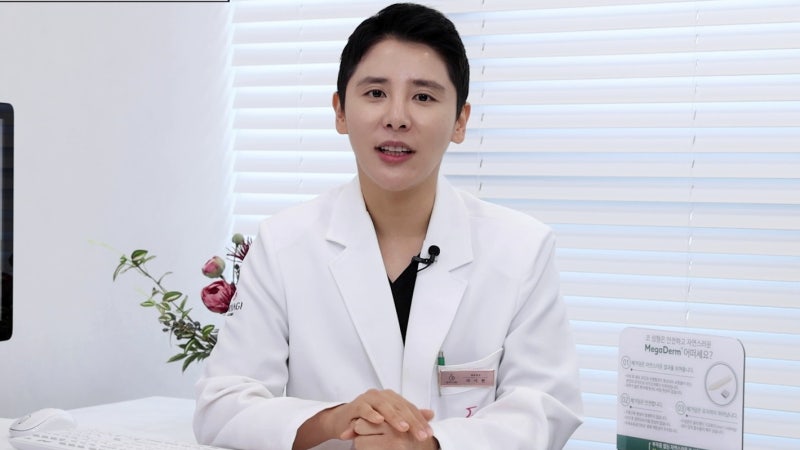
A doctor in a white coat speaks to the camera from a desk in the clinic.
Hello, this is Dojagi Clinic. If you came across this article while searching for dermatology clinics near Gangnam Station and are curious about Go Uri, we'll walk you through, step by step, what the ingredient is and who it suits best.

Park Si-hyun, head director of DOJAGI CLINIC: ENT specialist, Stanford training, and member of several cosmetic surgery societies.
View Dr. Park Si-hyun's full profile (Naver People Info)
This injection is a liquid formulation of an ingredient once used in dissolvable sutures. It spreads widely under the skin, forming a mesh-like scaffold that helps your own collagen build up along it. It tends to suit those who want to improve skin density and texture rather than volume.
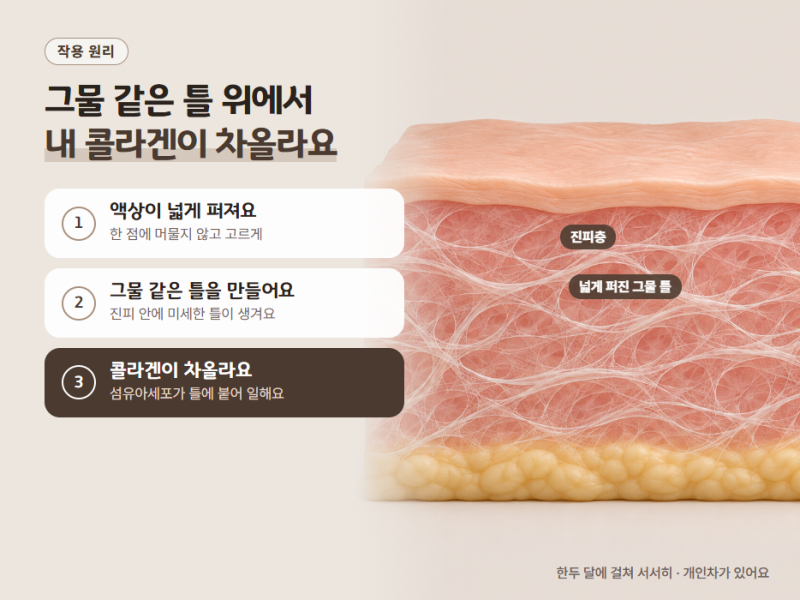
How it works: the liquid spreads, forms a fine net-like frame in the dermis, and your own collagen fills in over 1–2 months; results vary.
What ingredient is this injection made from?
The main ingredient is polycaprolactone, known as PCL. It has long been used in dissolvable sutures that close wounds after surgery, and it gradually breaks down in the body over time. According to the manufacturer, once broken down, it leaves the body as water and carbon dioxide.
Products using the same ingredient have been available before, but because they came in particle form, they stayed in one spot and were more geared toward building volume. This injection is different in that the PCL is fully liquefied, so it flows and spreads like water. It was first used overseas before being introduced to Korea.
The particle-type products required the powder to be mixed with water, so there was concern that it could clump if it didn't dissolve evenly. The liquid form skips this step, and many explanations note that it carries less risk of clumping. That said, data is still accumulating, so we can't say the risk is completely absent.
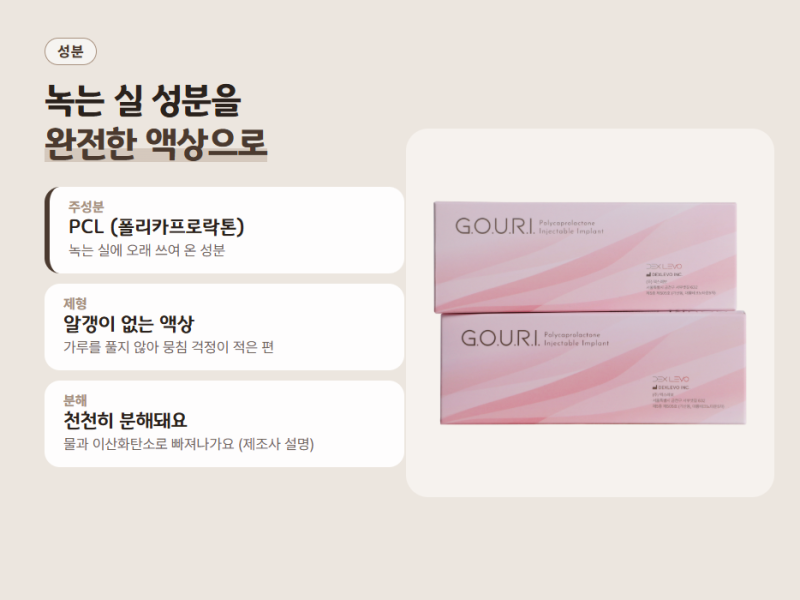
G.O.U.R.I.: PCL (polycaprolactone) from dissolving threads, as a particle-free liquid that slowly breaks down into water and CO2.
How does the injected solution turn into collagen?
PCL does not turn directly into collagen. Once injected, the ingredient spreads under the skin and forms a fine, mesh-like scaffold. Fibroblasts, the cells that produce collagen, attach to this scaffold and begin their work.
So the glow you see right after treatment is closer to the effect of the liquid itself, while the build-up of your own collagen appears gradually over one to two months. There's no need to worry if you don't see changes right away. Because the scaffold is maintained while the ingredient slowly breaks down, it's best to track results on a monthly rather than weekly basis.
Among collagen boosters, its biggest feature is that it spreads across a wide area to raise overall skin density, rather than filling a single spot.
How is it different from other skin boosters?
Concern | Option to Consider | Characteristic |
Wide-area fine lines | Liquid PCL | Spreads widely |
Sunken volume | Volume-type products | Fills one point |
Concern in one area | Area-specific products | Focuses on one area |
For areas where volume itself is needed, such as sunken cheeks or temples, volume-type products like Sculptra or Juvéderm Voluma, or filler, may be a better fit.
Because the liquid spreads so well, it's difficult to fill a single point precisely.

Particle types stay put to add volume; liquid types spread to fill density. Cheeks or temples needing volume may suit volume products or fillers.
Its mechanism differs from products that use different ingredients, such as Litou, so the right choice depends on whether your concern is texture across a wide area or a sunken spot in one place. It's much easier if you point out your most bothersome area by hand during your consultation.
Which areas is it best suited for?
Several specialists commonly point to the forehead and neck as areas where it works well. Fine lines that spread across the forehead need to be treated across a surface rather than a single point, and the product's spreading quality suits this kind of area. Neck wrinkles also cover a broad area, and the skin there is thin, so they are difficult to fill with filler. This is why the injection is often considered for the neck.
Treatment often involves using a blunt-tipped thin tube called a cannula to thinly distribute the solution along the lines. On the face, it is also used to refine texture across broad areas such as the front cheeks, making it a good fit for people who want overall firmness across the face rather than in just one spot.

Suited to broad areas rather than single points: forehead lines, the neck's wide, thin skin, and front cheeks for overall texture and firmness.
What about bruising and pain?
Anesthetic is often mixed into the injection solution, which can help reduce discomfort. That said, depending on the area, you may feel stinging or a dull ache.
Bruising is what to be aware of in advance. If a blood vessel is disturbed and blood spreads, the blood can remain trapped within the mesh-like scaffold, so the bruise may last longer than a typical one. That's why delicate technique that minimizes vessel damage matters, and lingering bruises are known to improve with treatments such as laser therapy. If you tend to bruise easily, be sure to mention it during your consultation.
Swelling may also occur right after treatment. In the manufacturer's clinical trials, swelling was the most common reaction, and most cases resolved within two weeks. If you have an important event coming up, it's a good idea to schedule the treatment with plenty of time to spare.

Anesthetic is mixed in to reduce pain. Bruises can linger, so say if you bruise easily. Swelling mostly fades within 2 weeks (maker data).
Check which of these describes your concern.
□ My concern is texture and density rather than volume
→ Start by looking into liquid PCL
□ My cheeks or temples look sunken
→ Volume-type products are also worth discussing
□ My concern is a broad area, such as the forehead or neck
→ Its spreading quality tends to suit these areas well
□ I tend to bruise easily
→ Let your provider know during your consultation
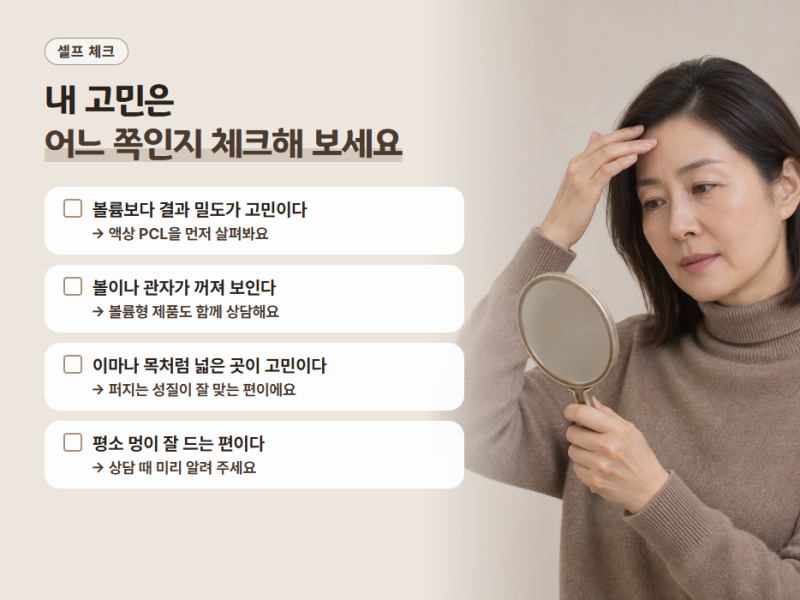
Self-check: texture concerns suit liquid PCL; hollow cheeks or temples may need volume products; forehead and neck suit it; mention easy bruising.
How should you choose a newly released injection?
For newly released injections, it's best to look at the ingredients and supporting evidence before the name.
Dr. Park Si-hyun worked as a researcher at the Cancer Center of Seoul National University Hospital and completed training at Stanford University School of Medicine. Dr. Park has also conducted procedure training for medical professionals in Thailand and Mexico.

A doctor in a white coat talks with visitors at the clinic.
Before choosing a treatment, Dojagi Clinic first assesses skin thickness and the area of concern, then follows a process of selecting the right product. Even with the same injection, the approach should vary from person to person. Here are some frequently asked questions.
Q. Is one session enough?
A. Treatment is often given in 2 to 3 sessions spaced one to two months apart, then continued at intervals of 6 months to 1 year. This can vary depending on skin condition.
Q. How long do the results last?
A. The manufacturer states that results last about 6 to 12 months. Specialists' explanations are similar to this range, though results vary depending on skin condition.
Q. Can it be combined with other devices?
A. Some people plan it alongside lifting devices such as radiofrequency. The order and timing are decided during your consultation.
Thinning skin is rarely a concern that appears overnight. It's a change that builds up little by little, which can make it all the more frustrating. That's why sorting out whether your skin needs volume or density first makes the choice much clearer. If you keep in mind the differences in ingredients and properties covered here, you'll find it easier to discuss the direction you want during your consultation.
※ Results and recovery vary from person to person, and side effects such as bruising, swelling, redness, and itching may occur.

Dojagi Clinic Parking Guide
Patients receiving procedures or surgery get 1 hour of free parking.
After the free period, 1,000 KRW is charged for every 10 minutes.
Valet service is also available (valet fee: 5,000 KRW).
This post is a medical advertisement written by the clinic for the purpose of providing medical information. It complies with Article 56, Paragraph 1 of the Medical Advertising Act. Results may vary depending on individual constitution and health status, so please make your treatment decision after sufficient consultation with your medical team.
Frequently Asked Questions
What ingredient is the liquid PCL injection made from?
The main ingredient is PCL (polycaprolactone). It has long been used in dissolvable sutures that close wounds after surgery, and it gradually breaks down in the body. According to the manufacturer, after it breaks down, it leaves the body as water and carbon dioxide.
When do the results appear?
The build-up of your own collagen usually appears gradually over one to two months. The glow right after treatment is closer to the effect of the liquid itself, so results are best tracked on a monthly rather than weekly basis.
Is one session enough?
Treatment is more often given in 2 to 3 sessions spaced one to two months apart rather than as a single session. It may then be continued at intervals of 6 months to 1 year, depending on your skin condition.
How long do the results last?
The manufacturer states that results last about 6 to 12 months. Specialists' explanations are similar to this range, though results vary depending on skin condition.
Which areas is it best suited for?
The forehead and neck are the areas that several specialists commonly identify as well suited. It is often considered for fine lines across the forehead and for neck wrinkles, which are difficult to treat with filler. It is also used to refine texture across broad areas of the face, such as the front cheeks.
Can bruising and swelling occur after treatment?
Yes, they can. In the manufacturer's clinical trials, swelling was the most common reaction, and most cases resolved within two weeks. If a blood vessel is disturbed and blood spreads, the bruise may last longer than a regular bruise, so be sure to mention it during your consultation.