2026-10-24
PDRN Cosmetics vs. Procedures: How Their Roles Differ (Banpo Dermatology)
Explains how PDRN cosmetics and skin-booster treatments differ, from surface hydration to dermal regeneration, plus ingredient label tips and FAQs.

Have you come across ampoules promoting skin-regenerating ingredients at cosmetics stores or on social media lately?

You've probably heard plenty about how good it is for the skin, but it may be confusing to understand how applying it differs from receiving it as a procedure. It's a name you hear often, yet it can be hard to explain exactly what it is.
In the exam rooms at Dojagi Clinic (Banpo Dermatology), this topic comes up several times a day and is one of our most frequently asked questions. Today, we'll walk you through, step by step, what role it plays when used in cosmetics versus when it's received as a procedure.
Is a serum you apply similar in effect to an injection?
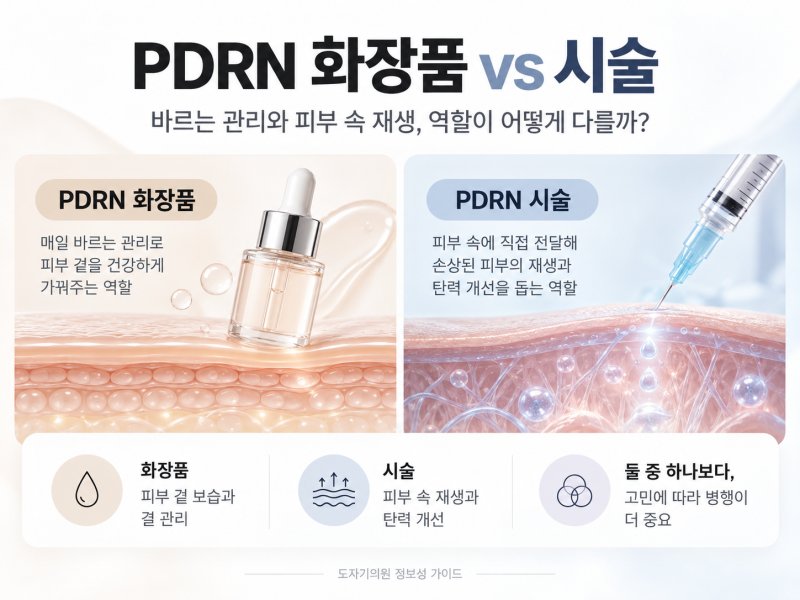
To cut to the chase, the two play different roles. Cosmetics are strong at caring for the skin's surface. Dull skin can become more hydrated, and its texture can feel smoother and more even. That makes them a solid choice for everyday moisturizing and consistent routine care.
Changes within the skin, such as new collagen building up, on the other hand, are considered the domain of procedures.
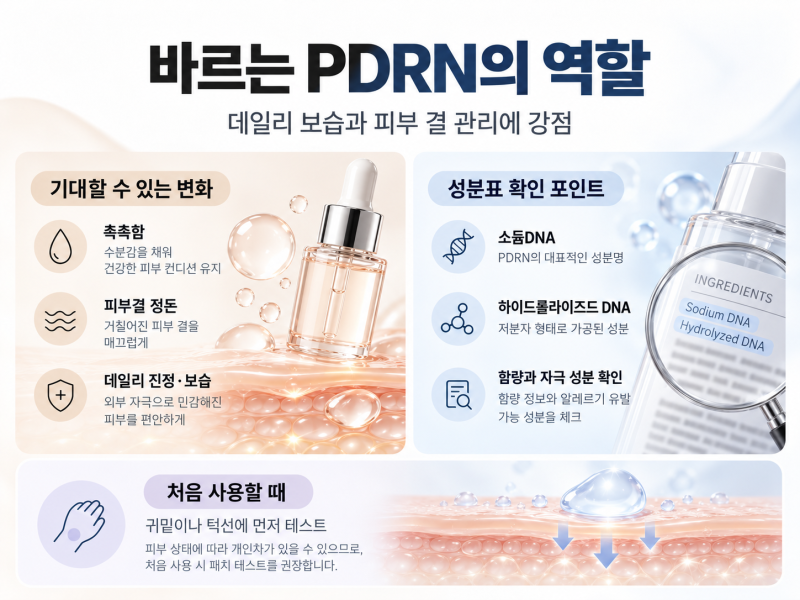
When choosing a PDRN cosmetic, it helps to check the ingredient list along with the product name. Ingredient labels list the official names as “Sodium DNA” or “Hydrolyzed DNA.” If you only see a different name, such as “salmon extract,” double-check that it contains the ingredient you're looking for. It also helps to look at how much is included, expressed in ppm (parts per million, a unit for very small amounts). Doing so makes choosing much easier.
If this is your first time using a product, keep in mind that other ingredients in it, such as fragrance, preservatives, retinol, or vitamin C, can irritate the skin. Try a small amount on the area below your ear or along your jawline first, then extend it to your whole face if there's no reaction. If your skin is sensitive, it's best to observe for a day or two.
What does this ingredient actually do in the skin?
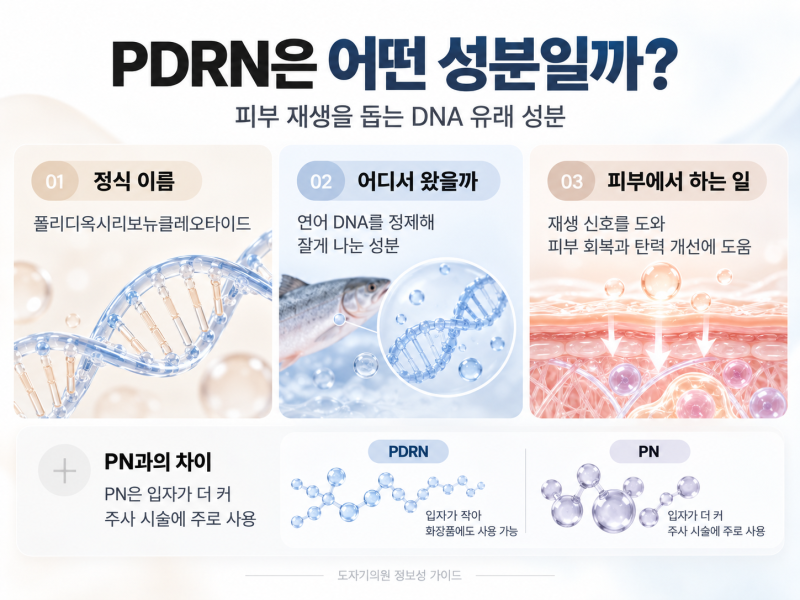
The full name of this ingredient is polydeoxyribonucleotide. It's a long name, isn't it? Simply put, it's DNA obtained from salmon, purified and cut into small fragments. Salmon DNA is fairly similar in structure to human DNA, so the body is known to accept it without much resistance.
On the surface of skin cells is an adenosine A2A receptor, a protein that acts like an antenna for receiving regeneration signals. When this ingredient attaches to that receptor, it's like flipping a regeneration switch. Fibroblasts (the cells that produce collagen and elastin) then start working actively, which can help the skin recover overall.
Procedures commonly called “salmon injections” in dermatology clinics belong to the same family. Rejuran's PN (polynucleotide) is the best-known example. You can think of PN as a sibling ingredient with larger particles. Because PN particles are large, it's mainly used as an injection. Ingredients with smaller particles are used in both injections and cosmetics.
Why do applying and injecting play different roles?
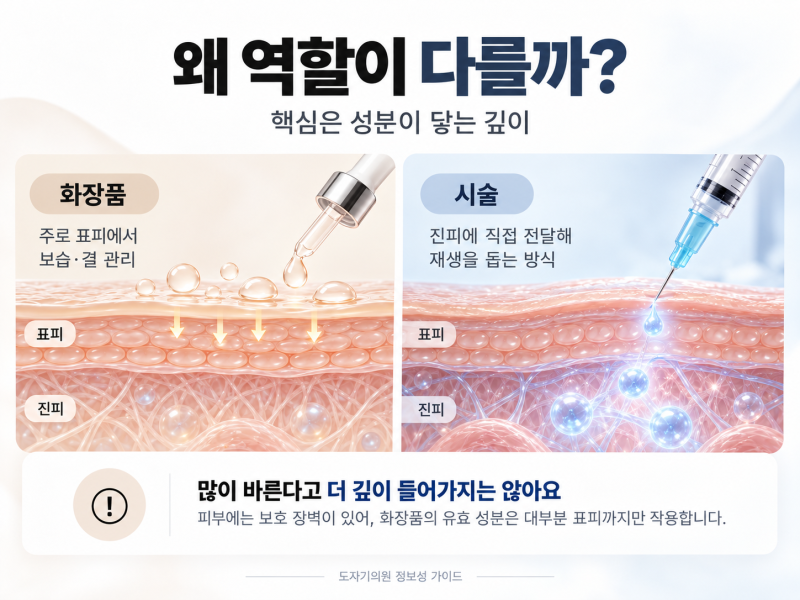
The key is how far the ingredient can reach into the skin. The outermost layer, the epidermis (the protective barrier that blocks external substances), does not readily let in substances above a certain size, since its job is to protect the body. That's why topically applied ingredients mainly help with moisture and skin texture within the epidermis. Procedures, on the other hand, directly replenish the dermis (the firm layer beneath the surface where collagen resides), where regeneration takes place.
Applying more doesn't drive it deeper, so rather than layering repeatedly, using an appropriate amount consistently is better and more comfortable for your skin. Some believe that using a galvanic (microcurrent) or ultrasonic home device together can help absorption a little. However, these approaches differ from procedures that deliver the ingredient directly to the dermis.
What changes can you expect from procedures?
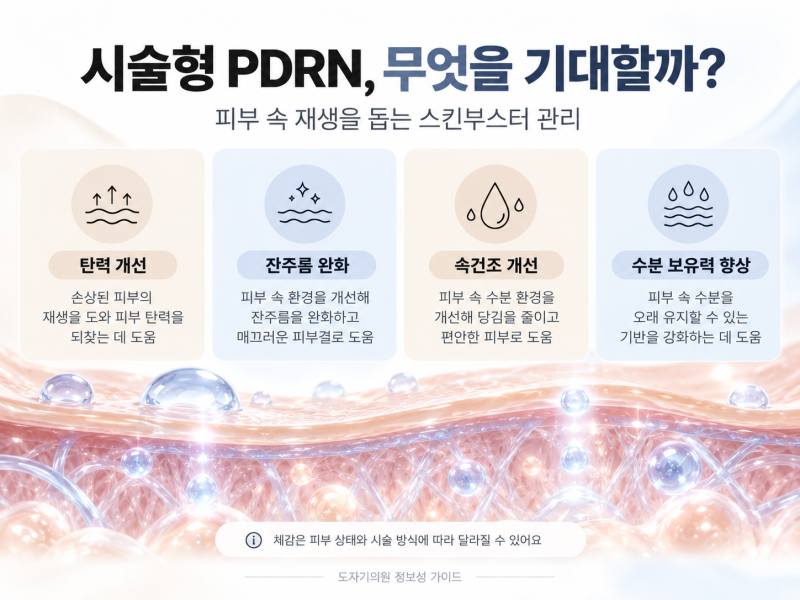
With skin booster treatments that deliver the ingredient directly into the dermis, the range of expected benefits is broader. The most frequently mentioned are firmness and fine lines. Since regeneration is its primary action, these points come up consistently in research and in clinicians' experience. Hydration benefits, such as improved dryness within the skin and better moisture retention, are also widely agreed upon by many clinicians.
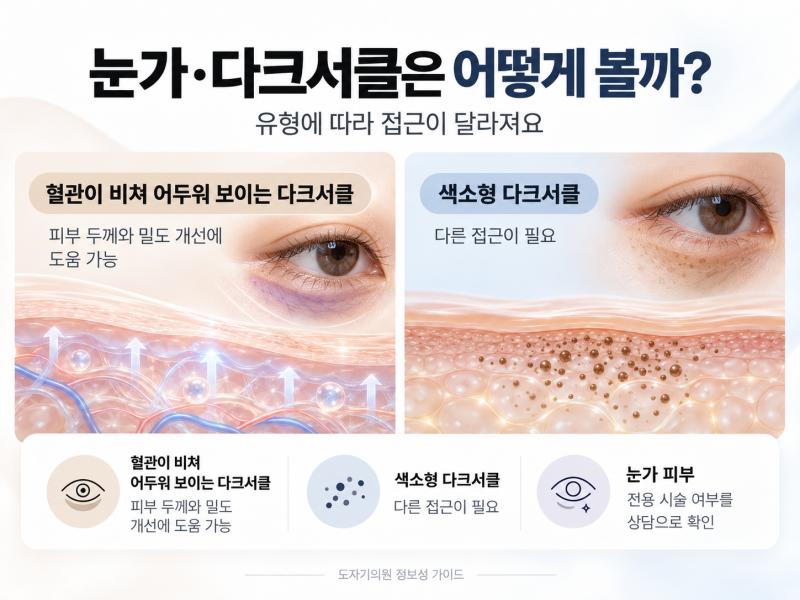
For dark circles that look bluish because blood vessels show through the skin, some believe an eye-area-specific treatment can help by thickening the skin and increasing its density, making the vessels less visible. Brown-looking dark circles caused by pigmentation, however, require a different approach, so it's important to first determine which type you have. Keep in mind that the effects of skin booster treatments can vary depending on the treatment area, the method, and your skin condition. Rather than aiming for a dramatic change all at once, it's best to space out sessions and give your skin time to recover in between.
Are there limitations even with procedures?
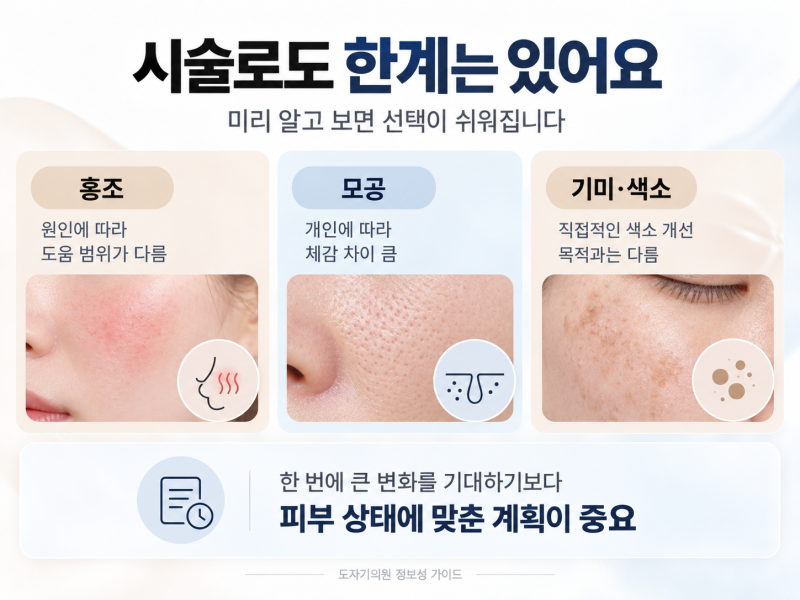
Yes, there are a few things worth knowing in advance. Redness should be assessed by its cause first. Many believe it helps with inflammatory redness on sensitive, dry skin, but its effect is limited for redness caused by acne-prone skin or photoaging (aging caused by sun exposure).
Opinions among clinicians are divided on pores. Some say they have seen a tightening effect, while others say the change is hard to notice.
Dark spots and pigmentation call for even more caution. This ingredient family cannot directly remove or suppress melanin (the pigment that gives skin its color). The clearer look some people notice after a procedure is generally seen as a secondary change that comes with increased hydration and firmness.
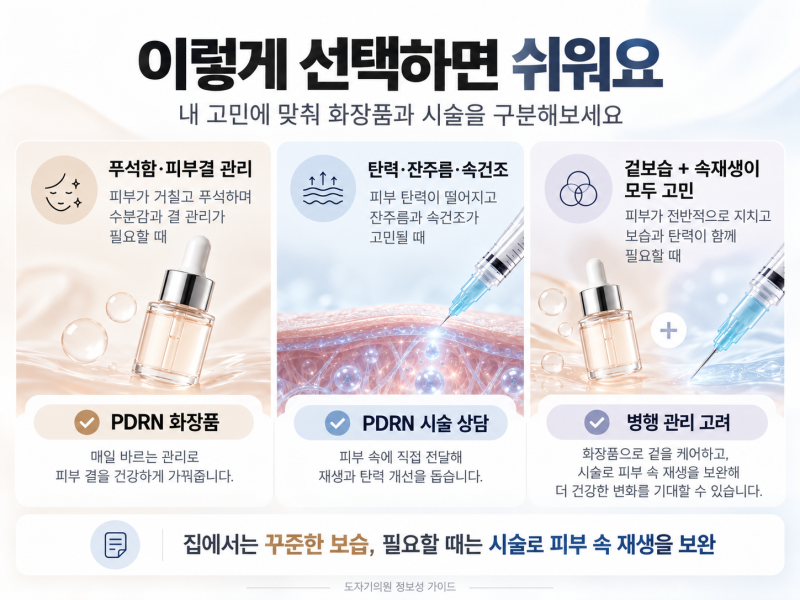
In summary, topical care handles hydration on the surface of the skin, while procedures handle regeneration within the skin. Neither is the only right answer. At home, it's a good idea to stay consistent with moisturizing and, when needed, add procedures to support the skin from within. Sorting out which of your concerns is closer to each approach will help you choose more wisely.
At Dojagi Clinic, we examine your skin directly and talk through whether topical care, a procedure, or a combination is the better fit for you, so feel free to ask any questions.
This post is a medical advertisement published by the clinic for the purpose of providing medical information, and it complies with Article 56, Paragraph 1 of the Medical Advertising Act. Results may vary depending on individual constitution and health condition, so please make treatment decisions after thorough consultation with your medical team.
Frequently Asked Questions
Will applying PDRN cosmetics give the same results as a procedure?
The two play different roles, so they are hard to consider equivalent. Cosmetics are strong at moisturizing and caring for the skin's surface, while the buildup of new collagen within the skin is considered the domain of procedures.
What names does a PDRN cosmetic's ingredient list use?
The clinic notes that ingredient lists show the official names Sodium DNA or Hydrolyzed DNA. If you only see a different name, such as “salmon extract,” double-check whether it's the ingredient you want.
How should I patch-test a PDRN product I'm using for the first time?
The clinic recommends applying a small amount to the area below your ear or along your jawline first, then extending use to your whole face if there's no reaction. Other ingredients, such as fragrance, preservatives, retinol, and vitamin C, can irritate the skin, so if your skin is sensitive, it's best to observe for a day or two.
What changes can I expect from skin booster treatments?
The most commonly mentioned expected benefits are firmness and fine lines. Improvements in hydration, such as relief from dryness within the skin and better moisture retention, are also agreed upon by many clinicians. Results can vary depending on the treatment area and skin condition.
Does PDRN treatment also improve melasma or pigmentation?
This ingredient family cannot directly remove or suppress melanin. Dark spots and pigmentation therefore require more careful evaluation. The clearer look some people notice after treatment is considered a secondary change.
Can PDRN treatment help with redness?
Redness depends on its cause. Many believe it helps with inflammatory redness on sensitive, dry skin. However, its effect is limited for redness caused by acne-prone skin or photoaging (aging caused by sun exposure).