2026-11-06
Shinnonhyeon Station Dermatology Thermage: Why Satisfaction Varies for the Same Procedure
Thermage gradually firms skin through heat-driven collagen changes. Results vary by area, shot count, and skin condition, so plan around your own needs.


Cover image with a model: “Thermage: why firmness returns naturally.”
Sometimes, when you look at a photo,
your facial contour seems a little heavier than before,
or your skin doesn't look firm
even with makeup on.
When that happens, you start looking into lifting treatments,
and the name Thermage keeps showing up
alongside Shinnonhyeon Station dermatology clinics.
But when you read reviews from people who've actually had the treatment,
you'll see stories of satisfaction
alongside stories of results that weren't
as dramatic as expected,
which can make it even more confusing.
In fact, Thermage isn't a treatment that lifts your face
all at once,
but one that gradually tightens
your skin's own elasticity and texture.
That's why it's important to first clarify
what kind of change you want.
Does Thermage make the jawline look more defined?
If your facial contour feels blurred,
all lifting treatments may seem pretty similar.
But Thermage doesn't work by carving out the jawline
the way some contouring methods do.

Thermage suits reduced firmness, fine lines, pore and texture concerns, and dull, loose skin. It targets texture and firmness over contour.
If your skin has thinned and fine lines have increased,
or your skin overall feels loose,
it's a better match for reinforcing elasticity.
On the other hand, if you're dealing with a double chin or sagging cheeks
and need deeper-layer lifting first,
an ultrasound-based treatment like Ulthera
may be a better fit.
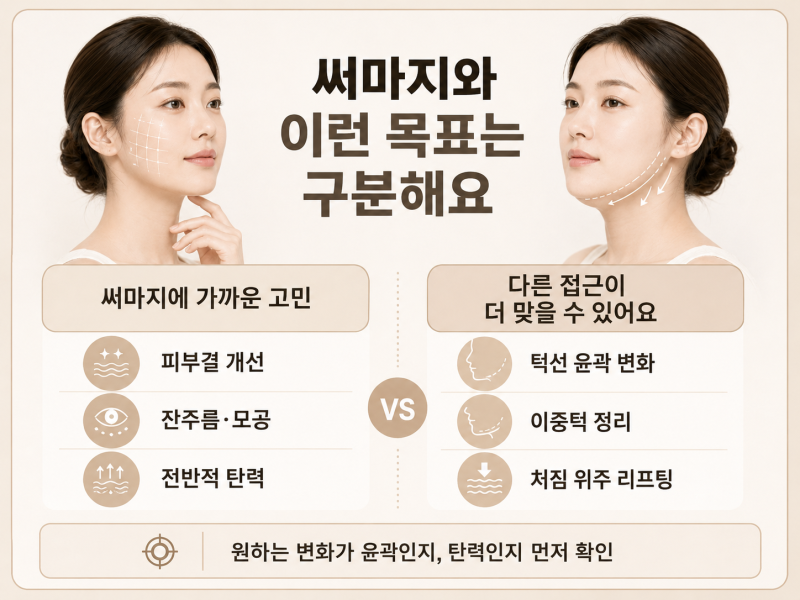
Thermage fits texture, fine lines, pores and overall firmness; jawline, double chin or sagging may suit other options. Decide your goal first.
In other words, you need to decide whether you want
to lift your facial contour first,
or to firm up your skin itself.
What happens inside the skin?
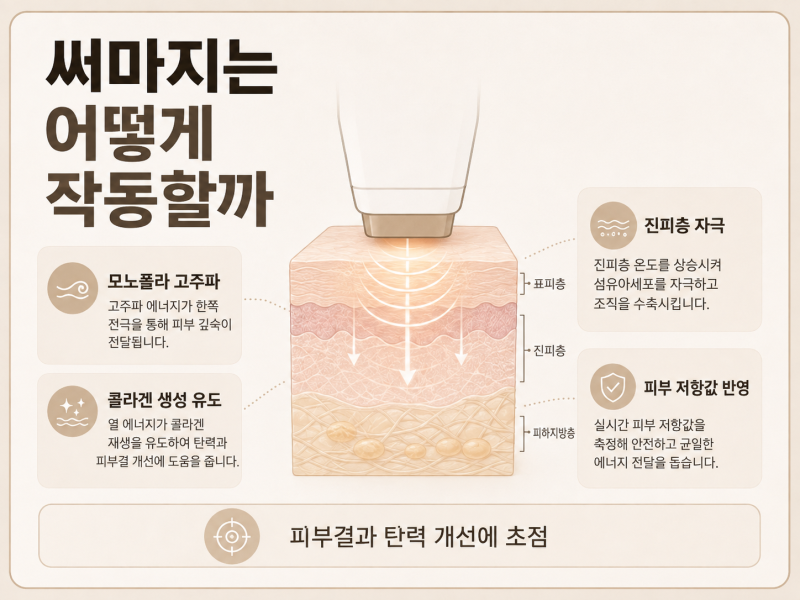
How Thermage works: monopolar RF heats the dermis and induces collagen, while real-time impedance readings help deliver energy evenly.
Thermage delivers monopolar radiofrequency energy
to the dermis, creating a heat stimulus
that triggers changes in collagen.
Right after the procedure, you may first notice
a slight tightening sensation,
and over the following few weeks,
your skin gradually firms up.
This is also why it's hard to judge the Thermage effect
by looking at just the next day.
You tend to notice more improvement when you have
concerns close to the skin's surface,
such as fine lines around the eyes or pores,
along with overall loss of facial firmness.
300 shots vs. 600 shots: is a higher number always better?
This is where many people get confused:
the number of shots.
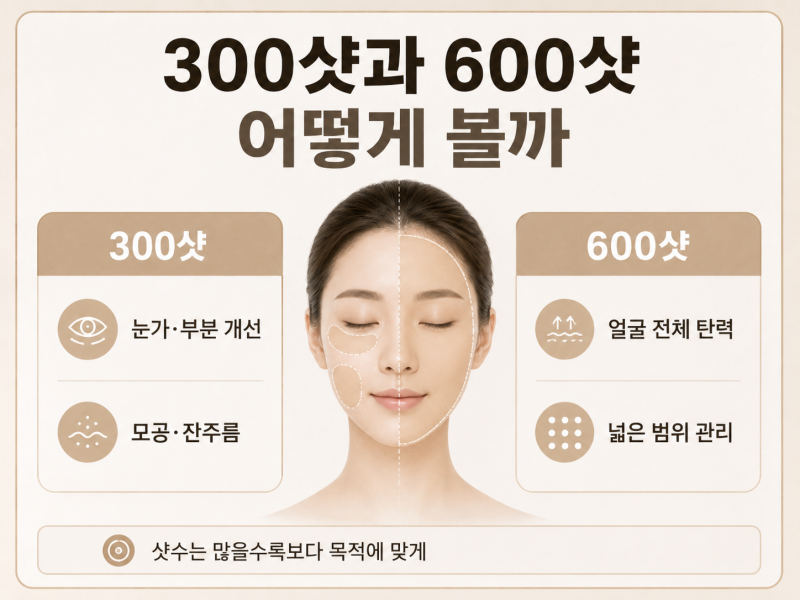
300 shots: eye area, partial care, pores and fine lines. 600 shots: full-face firmness, wider areas. Choose by purpose, not by a higher count.
Treating areas like around the eyes or cheeks
and aiming for overall facial firmness
call for different treatment coverage,
so the required range is different.
So choosing 600 shots isn't always
the better option.
The number of shots you need depends on face size, skin thickness,
and the extent of your loss of firmness.
But even with the same number of shots,
which area they're placed on and how
they're arranged matters even more.
Rather than starting with a number,
it's better to first look at
which area of your face has become
the loosest.
If it doesn't hurt, does that mean it's not working?
This question comes up a lot too.
Thermage pain varies widely from person to person,
and the sensation differs by area too.
Areas close to bone or where the skin is thin
may feel more sensitive,
while areas with more thickness, like the cheeks,
may feel different.
However, stronger pain doesn't mean
the treatment is more effective.
Rather than enduring too much, it's more important to have
the energy adjusted to your skin condition and the treatment area.

Timeline: tightness right after, firmer at 2–4 weeks, collagen at 1–3 months, then gradual texture improvement rather than sudden change.
Why do results feel different with the same device?
Skin thickness and resistance differ
from one area of the face to another.
That's why delivering the same level of energy
to the forehead, eye area, front cheeks, and jawline
isn't a natural approach.

Three factors behind different results: shots set to your goal, pain control (too weak reduces effect), energy by area. Design beats equipment.
Thermage checks skin resistance with every shot
as it delivers energy,
but actual results can also vary
depending on how carefully each area
was assessed and planned.
Thinner areas call for a more conservative approach,
while areas with significant loss of firmness
need a more thorough treatment.
So rather than focusing on the device name alone,
what matters is how you divide and evaluate
the whole face.
Be sure to check your skin condition before treatment, too.

Pre-treatment checks: skin thickness, sagging, UV exposure, inflammation, recent pregnancy or childbirth. Diagnosis comes before packages.
If your skin is inflamed or breaking out,
it's better not to force your schedule
but to first calm your skin
before proceeding.
If you've recently had another laser or a skin booster,
you should also check the timing of that treatment
and how well your skin has recovered.
Even with the same Thermage treatment,
your skin may react differently on a sensitive day
than on a day when you feel good.
How long do the results last after one treatment?

Duration: several months to about a year, varying with firmness, age, lifestyle and sagging. Your skin's condition matters more than numbers.
The duration of Thermage results
is hard to pin down to a single number.
That's because how long you feel the effects depends on
skin firmness, age, sun exposure,
lifestyle habits, and the treated area.
It's commonly said to last anywhere from a few months to about a year, but even with the same treatment,
people with better skin condition may enjoy results for longer,
while those with more advanced loss of firmness may find it shorter.
Rather than repeating the treatment right away
just because the effects seem to fade,
it's better to give the collagen changes time to settle
and then consider your next session.
Give your skin a little rest for a few days after treatment.

Aftercare: moisturize, block UV and reduce irritation; briefly avoid alcohol, saunas and strong massage. Take extra care in the first few days.
Even if downtime is minimal,
your skin has been exposed to heat
right after the procedure.
Make sure to moisturize and use sun protection,
and for a few days, cut back on activities
that add heat or stress to your skin,
like saunas or heavy drinking.
If your skin barrier is sensitive,
it can also help to keep your skincare routine
simpler than usual.
Results aren't determined on the day of treatment alone.
You need to consider the entire recovery process
as your skin heals afterward.
Is it better to combine it with Ulthera?
If you want both skin firmness and deeper lifting,
you may have heard of a combination called Ulthermage
(Ulthera plus Thermage).
Ulthera focuses on lifting the deeper layers,
while Thermage works to refine skin firmness and texture,
so combining them targets different layers.
That said, combining the two
doesn't automatically make it better.
If you have little facial fat or thin skin,
an intense energy combination may be too much,
so the sequence and spacing
may need to be planned separately.
Ultimately, you need to decide
what change your own skin needs first.
Thermage shines when it comes to naturally refining
skin texture and firmness that feel lost
or worn down.
On the other hand, if your priority is to significantly change your contour
or strongly lift sagging tissue,
it's worth comparing other lifting options
before deciding.
When you look in the mirror, don't just focus on your jawline.
Also check fine lines around your eyes,
the firmness of your cheeks, and your skin thickness.
Rather than simply more shots or stronger energy,
what matters is precisely planning
the amount your skin actually needs.
In the end, the difference in satisfaction starts right here.
This post is a medical advertisement written by the clinic for the purpose of providing medical information. This post complies with Article 56, Paragraph 1 of the Medical Advertising Act. Results may vary depending on individual constitution and health status, so please make your treatment decision after thorough consultation with your medical team. |
Frequently Asked Questions
Why do results differ from person to person even with the same Thermage treatment?
Because skin thickness and resistance differ across areas of the face, results can vary even with the same device. Outcomes can depend on which areas are evaluated and how the treatment is planned, so it's important to look at the whole face by dividing it into areas.
When do the effects of Thermage start to show?
Right after treatment, you may first notice a slight tightening sensation, and over the following few weeks your skin gradually firms up. For this reason, it's hard to judge the effect by looking only at the next day.
Does more shots always mean better results?
No, not always. The number of shots you need depends on face size, skin thickness, and the extent of firmness loss. Where and how the shots are placed matters more than the number alone.
If it doesn't hurt, does that mean the treatment is weak?
It's hard to judge the strength of the effect by pain alone. Pain varies greatly from person to person and by area, and stronger pain doesn't mean better results. It's important to adjust the energy to your skin condition and the treatment area.
How long do the effects of Thermage last?
It's commonly said to last from a few months to about a year, but individual differences are large, so it's hard to give a single number. How long the effects last depends on skin firmness, age, sun exposure, lifestyle, and the treated area. Even when the effects fade, it's better to allow time before repeating the treatment rather than doing it right away.
How should I care for my skin for a few days after treatment?
For a few days after treatment, it's a good idea to give your skin a little rest. Keep up with moisturizing and sun protection, and for a few days, cut back on activities that add heat or stress to your skin, such as saunas or heavy drinking.