2026-11-01
Banpo Dermatology Photon Therapy: Why Blood Color Changes and How the Process Works
A guide to photon therapy at Dojagi Clinic (Banpo Dermatology): how a portion of blood is treated with UVC light and oxygen, why its color turns bright red, and medication precautions.


Cover: "Why does blood change color? Photon therapy" over a photo of a smiling woman in a navy shirt.
Have you ever felt a little scared just hearing that blood is drawn out of the body and then put back in? As we get older and start looking into ways to take care of our health, it is a name you are likely to hear at least once. You may have heard people around you mention having it done, but you have probably never had it explained in detail. You have also probably heard that blood looks a different color when it is drawn than when it is returned, and you may be wondering what that means.
Hello, this is Dojagi Clinic at Banpo Dermatology. If you opened this article because you are curious about photon therapy (광양자치료), we have organized the most frequently asked questions so you can go through them one by one.
Profile of Dr. Park Si-hyun, head of DOJAGI Clinic and ENT specialist: past clinic posts, society memberships, Stanford medicine training.
Here is the key point first. This treatment briefly draws a portion of your blood outside the body, exposes it to ultraviolet light, adds oxygen, and then returns it to your body. The blood turns bright red because oxygen binds to it again. Any medications you are already taking should continue as usual.
What exactly is done with the blood once it is drawn?
The process is simpler than you might expect. Blood drawn from a vein in the arm is slowly passed through a machine while being exposed to 254nm ultraviolet light, commonly known as UVC. Oxygen is added along the way, and the blood is then returned to the body. Some clinics also offer the same treatment under the name Photontherapy (포톤테라피).
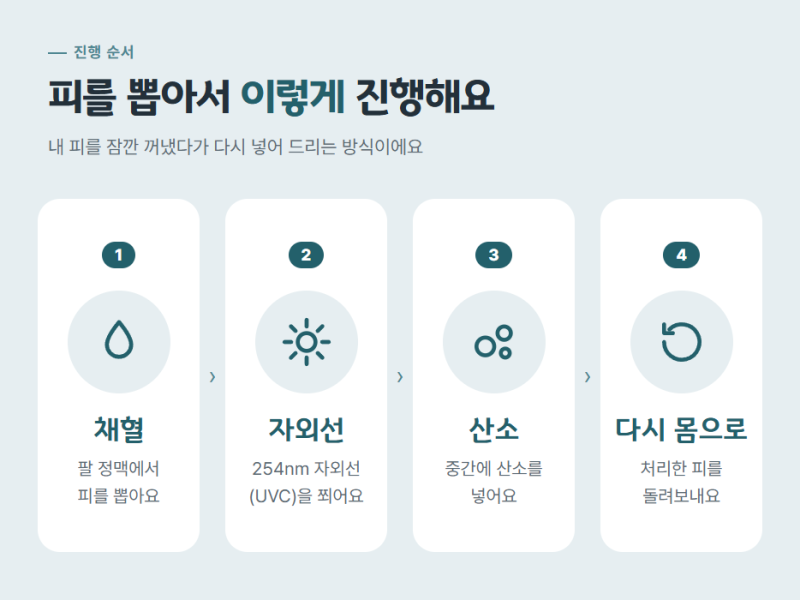
Treatment steps: 1) blood drawn from an arm vein, 2) 254nm UVC light applied, 3) oxygen added, 4) treated blood returned to the body.
Hemapure, the device used at Dojagi Clinic, has been approved by the Korean Ministry of Food and Drug Safety (MFDS) as a Class IV medical device. When a device is approved, its intended use is specified as well. Hemapure's approved use is the improvement of blood flow disorders. In plain terms, it is meant to address problems in the flow of blood.
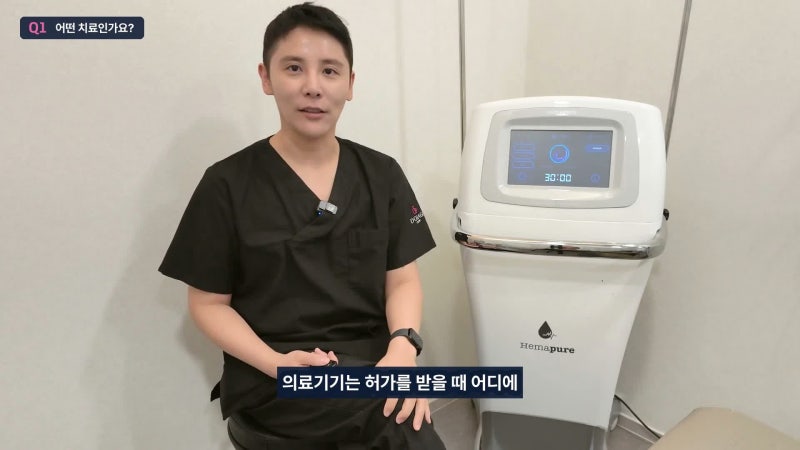
Video Q1 "What kind of treatment is it?": Dr. Park Si-hyun next to the Hemapure device, explaining how medical devices get approved.
Medical devices are classified from Class 1 to Class 4 according to their impact on the body. Class IV devices are not simply reported for use; they must go through MFDS approval review. That is why the approved use is the most accurate starting point for understanding what to expect from this treatment.
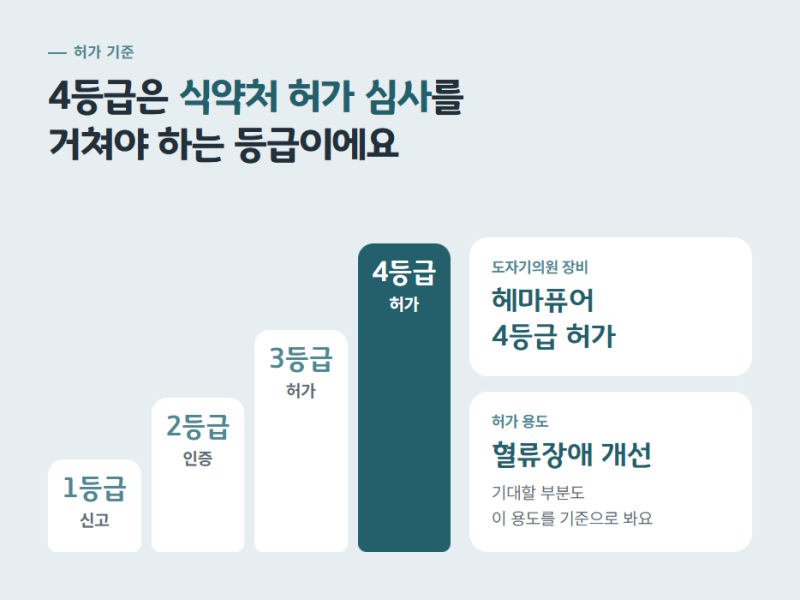
Device classes 1–4: the clinic's Hemapure is Class 4, approved by Korea's MFDS for improving blood flow disorders.
The amount seems small compared with all the blood in the body. Is that okay?
An adult body has roughly 5 liters of blood circulating. This method was designed from the start to draw out and expose only about 5–7% of the total, not all of it. 5–7% of 5 liters is roughly 250–350 mL.
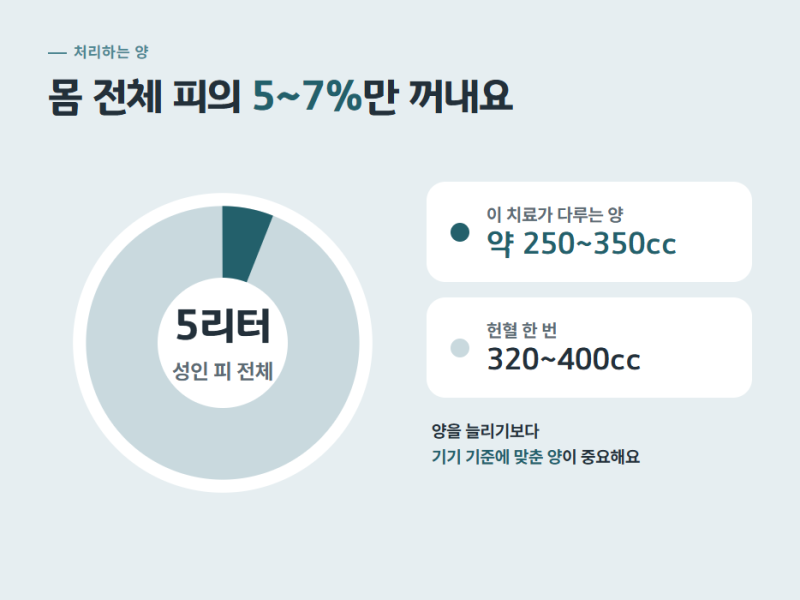
Only 5–7% of the body's blood is processed: about 250–350cc of an adult's 5 liters, versus 320–400cc for one blood donation.
Records from the original experiments indicate that exposing a larger volume of blood to light did not produce better results. So rather than increasing the amount, it is far more important to stay within the volume set by the device's standards.
Category | One blood donation | This treatment |
Volume | 320–400 mL | 5–7% of total |
Blood | Out of the body | Back into the body |
Does the blood become cleaner when its color changes?
When blood changes from dark red to bright red, it does not mean the blood has become cleaner. It is because of oxygen. Blood color is determined by how tightly the hemoglobin inside red blood cells holds onto oxygen. Venous blood, drawn from the arm, has given up oxygen to tissues throughout the body on its way back, so it is only about 75% saturated with oxygen and looks dark red. Arterial blood, which has just left the heart, is more than 95% saturated and appears bright red.
When oxygen is added to the blood bag, the venous blood takes oxygen back on and turns the same bright color as arterial blood.
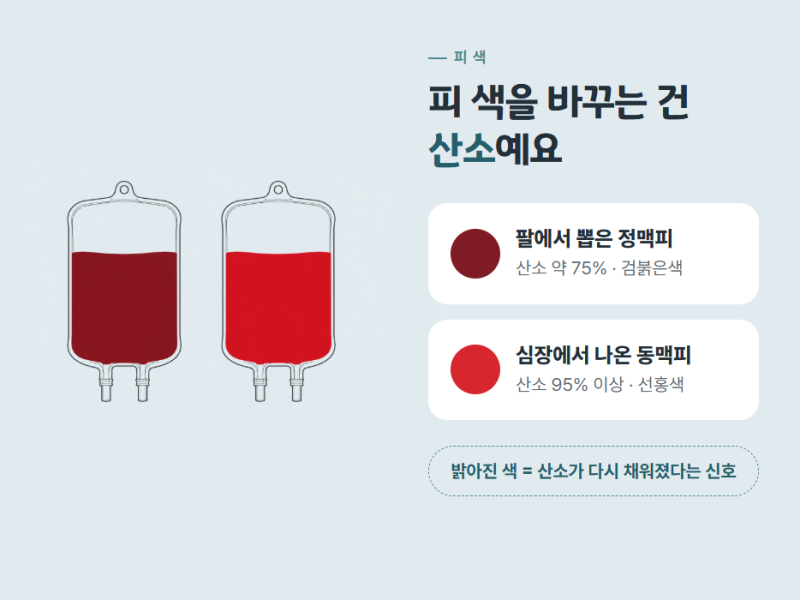
Oxygen sets blood color: arm venous blood (~75% O₂) is dark red, arterial blood (95%+) bright red; brighter means oxygen refilled.
So if venous blood looks dark, that does not mean it is spoiled or bad. It has simply released oxygen on its way back, so that is its normal color. A brighter color is best understood as a sign that the blood has been re-oxygenated. Watching the video in which Dr. Park Si-hyun explains this directly may also make it easier to understand.
Is it safe to draw blood out and then return it?
It is natural to feel concerned when you hear that blood is taken out of the body and then returned. In terms of volume, a blood donation draws 320–400 mL at once, and even under the original method, this treatment handles no more than a single blood donation's worth. Because the blood leaves and re-enters the body, hygiene is the top priority. Blood left outside the body will clot, so a process to prevent clotting is also applied.
Since everyone's physical condition is different, we ask about the medications you are taking and any conditions you have before treatment. If questions come up during the procedure, feel free to ask at any time. The more unfamiliar a procedure is, the better it is to hear each step explained and feel at ease before going ahead.
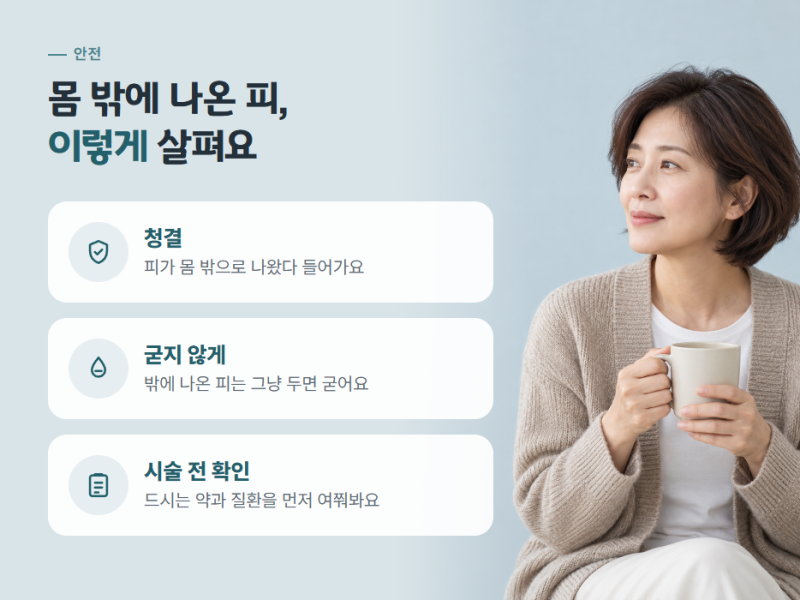
Handling blood outside the body: hygiene, preventing clotting, and checking your medications and health conditions before treatment.
I am already taking medication. Can I still receive this treatment?
We get this question very often. Many people also want to know whether they can reduce their medication after the treatment. This treatment is not a substitute for blood pressure, diabetes, or cholesterol medication. Do not reduce or stop any prescribed medication on your own; keep taking it steadily as before. Stopping blood pressure medication on your own can cause your blood pressure to rise again, so any decision to reduce or change medication should be made while monitoring your current blood pressure.
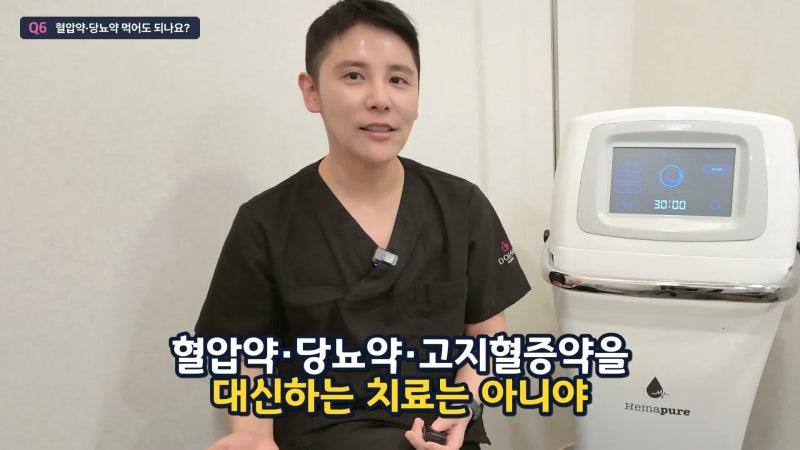
Video Q6 on blood pressure and diabetes drugs: the doctor notes this treatment does not replace BP, diabetes or cholesterol medication.
Check the following before treatment:
□ I take medication every day
→ Write down the names of your medications in advance.
□ I am being treated for a condition
→ Feel free to mention it during your consultation.
□ I have specific expectations
→ We will review them together based on the device's approved use.
At Dojagi Clinic, our standard practice is to ask about the medications you take and any conditions you are being treated for before treatment, review together whether it is appropriate for you now, and only then begin.
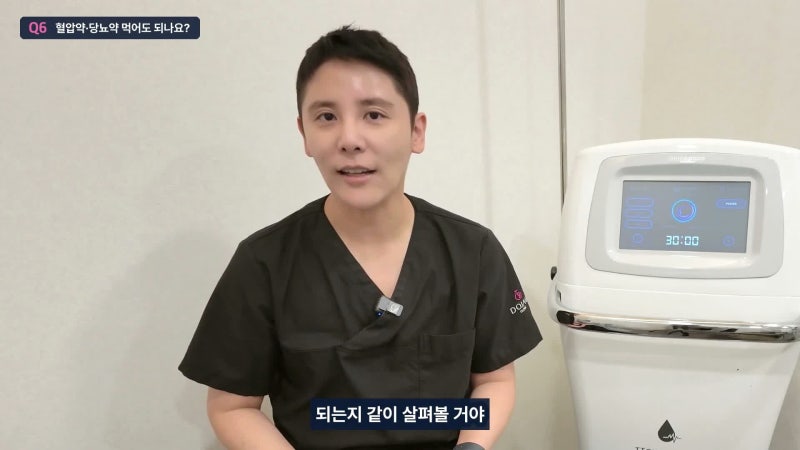
Video Q6 continues: the doctor says, "We'll look into it together to see whether it's okay."
Here are a few more frequently asked questions.
Q. Does it help with skin or fatigue?
A. The most accurate way to understand what to expect is to look at the device's approved use. Tell us what you are hoping for first, and we will review it alongside your current physical condition.
Q. Can I see the color change for myself?
A. The blood bag looks different before and after processing, so you can see the difference with your own eyes. Just remember that the difference comes from oxygen.
Drawing blood out may feel unfamiliar and worrying in itself, but once you understand the process, making a decision becomes much easier. To sum up, remember these three things: a portion of your blood is briefly drawn out, treated with light and oxygen, and returned to your body; the color change is due to oxygen; and any medications you take should continue as prescribed. Keeping these in mind will make your consultation go much more smoothly.
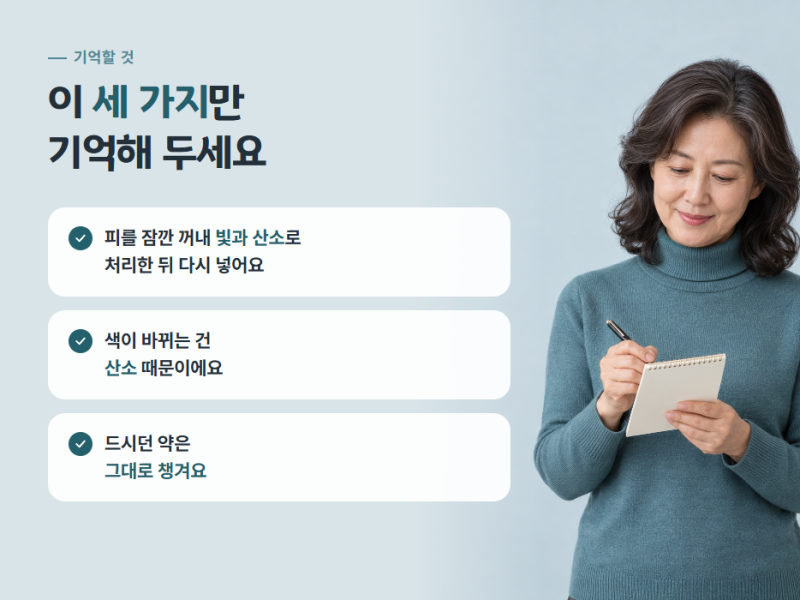
Remember three things: blood is briefly drawn, treated with light and oxygen and returned; oxygen changes its color; keep your usual medicines.
Please go over any questions one by one during your consultation.
※ Treatment results may vary from person to person. We check your physical condition before proceeding with treatment.

Dojagi Clinic Parking Information: Patients receiving treatment or surgery get one hour of free parking. After the free period, an additional 1,000 won is charged for every 10 minutes. Valet service is also available (valet fee: 5,000 won).
This post was written by the clinic for the purpose of providing medical information and is a medical advertisement. It complies with Article 56(1) of the Medical Advertising Act. Results may vary depending on individual constitution and health condition, so please make treatment decisions after a thorough consultation with your medical team.
Frequently Asked Questions
What exactly is photon therapy?
Photon therapy is a treatment in which a portion of the blood is briefly drawn out of the body, exposed to 254nm ultraviolet light (commonly known as UVC), supplemented with oxygen, and then returned to the body. It is described as a process in which blood drawn from a vein in the arm is slowly passed through a machine during treatment.
Does it only process a small portion of the body's total blood?
Yes. It is described as processing about 5–7% (roughly 250–350 mL) of the approximately 5 liters of blood in an adult body. This is no more than a single blood donation (320–400 mL), and records from earlier experiments indicate that exposing a larger volume to light did not yield better results.
Does the blood become cleaner when its color turns bright red?
No. The color change is due to oxygen binding again, not because the blood has become cleaner. Blood color is determined by how much oxygen the hemoglobin in red blood cells is holding. The article explains that venous blood looking dark does not mean it is spoiled or bad blood.
Can I receive this treatment if I am already taking medication?
Before treatment, your current medications and any ongoing conditions are checked first, and the medical team reviews together whether it is appropriate for you now. Prescribed medications should not be reduced or stopped on your own and should continue as prescribed.
Does it help with skin or fatigue?
This article does not make claims about skin or fatigue. The most accurate way to understand what to expect is based on the device's approved use (improvement of blood flow disorders). If you share what you are hoping for, it can be reviewed alongside your current physical condition.
Has the device used for the treatment been approved by the MFDS?
Yes. Hemapure, the device used at Dojagi Clinic, has been approved by the MFDS as a Class IV medical device, with an approved use of improving blood flow disorders. The article explains that Class IV devices are not simply reported for use but must pass MFDS approval review.