2026-10-26
Sinnonhyeon Station Dermatology: The Real Reason Nasolabial Folds Form
Explains why nasolabial folds form, how aging and daily habits affect them, and a simple at-home self-check to identify your fold type.


Have you ever sighed in front of the mirror at the long line that runs down from beside your nose?
When my face looks especially tired in photos,
that line is the first thing
that somehow catches my eye.
It's a line that's hard to cover even with makeup,
so it probably bothers you even more.
Hello, this is Sinnonhyeon Station Dermatology,
Dojagi Clinic.

Today, we'll take a closer look at something
many of you have been curious about:
why nasolabial folds form, and what type of fold
is hiding on your face. Let's go through it step by step.
Is it true that smiling a lot makes your nasolabial folds deeper? Is it because I smile so much?
To answer right away, smiling alone
doesn't cause them.

The corners of your mouth move constantly
when you talk, chew, or make facial expressions,
so all of that movement
gradually takes its toll.
Some even say that the habit of unconscious
frowning is the bigger problem, while others
argue that making few facial expressions
lets the center of the face sag faster.
In particular, if you often turn down the corners
of your mouth or press your lips together tightly
as a habit, the same area gets pressed over and over.
And here's one fact I really want you to know!
This line is a natural structure
that even newborn babies have.
So there's no need to force yourself
to hold back your smile at all.
So what exactly is this line beside the nose?
In medical terms, it's called the nasolabial fold.
The area inside the line, near the philtrum,
has thin skin and little fat, so it sits snugly
against the bone, while the outer cheek has
thicker skin and more fat, so it is
attached a bit more loosely.
It's easier to understand if you think of it
as the border where two neighborhoods with different characters meet.
The problem is that as we age, the multiple layers
around this border all change together.
As collagen and elastic fibers in the skin decrease,
the skin thins and sags without firmness.
As the fat that plumps up the front of the cheeks decreases,
front-cheek volume loss develops, and the cushion
that supported the line disappears.
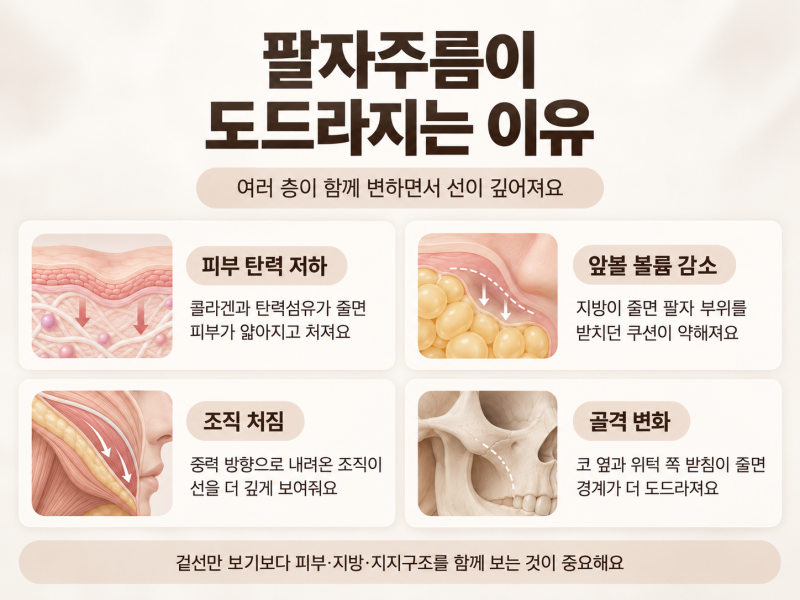
When the fascia, which acts as a support
holding the face in place, loosens,
the sagging tissue piles up on top of the line,
and the bones beside the nose and along the upper jaw
gradually recede inward, lowering the support beneath.
It's similar to an old sofa cushion that has sunk in,
with the seams along its edges sticking out.
That's why it's important to look at the underlying structure,
not just judge by the surface.
Even at the same age, depending on which layer weakens first,
the shape and depth of the line can look completely different
from person to person.
Why do some people's nasolabial folds show earlier than their peers'?

Some people have much more defined lines
even at the same age.
Lifestyle habits and natural facial structure
often play a big role.
UV rays from sunlight break down elastic fibers,
and smoking and frequent drinking interfere
with the production of new collagen,
accelerating the skin's aging clock.
Habits like sleeping on only one side, resting your chin on your hand,
and chewing only on one side of your mouth
keep one side of the face creased again and again,
which can easily lead to asymmetrical nasolabial folds.
No one's face is perfectly symmetrical to begin with,
but if only one side looks especially deep,
take a moment to review your daily posture.
Losing a lot of weight in a short time
can also make the line stand out,
as facial volume and moisture drop away together.
Managing your weight slowly and steadily
is much better for your face.
If you have a bone structure with a protruding mouth or cheekbones,
or a face where the line beside the nose naturally forms when you smile,
the line may be visible from a young age.
In cases like these, skincare alone has its limits,
so it's important to consider an approach that matches the cause.
Sometimes it helps to look at a broader range of options,
including approaches that address the root cause,
such as orthodontic treatment.
Is there a way to check what type of nasolabial fold I have at home?
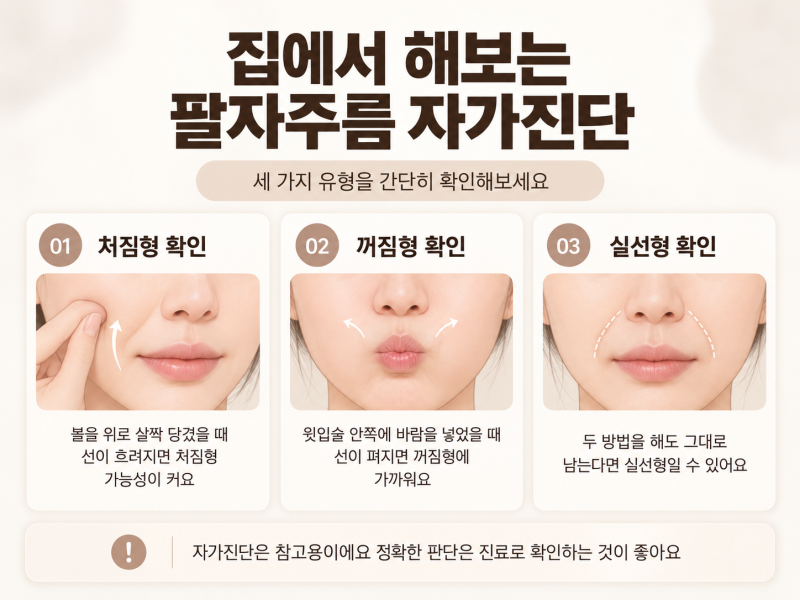
All you need is a mirror to do
a simple self-check for your nasolabial folds.
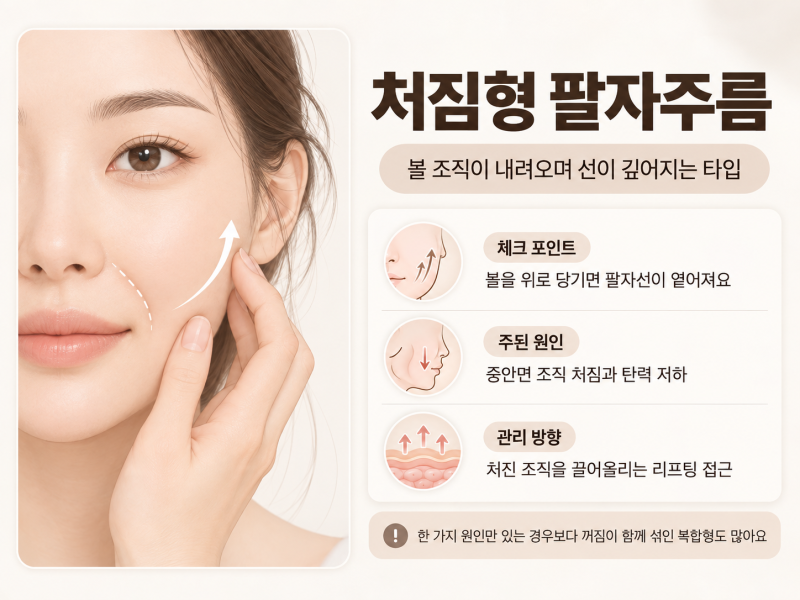
First, use your fingers to gently lift
your cheeks upward.
If the line fades or disappears,
it's closer to the sagging type, where the tissue has slid downward.
In this case, a nasolabial fold lifting approach that pulls up the sagging tissue tends to be a good fit.
Second, hold air inside your mouth
to puff out your upper lip.
If the line smooths out at this point,
it's the hollow type, where volume has been lost.
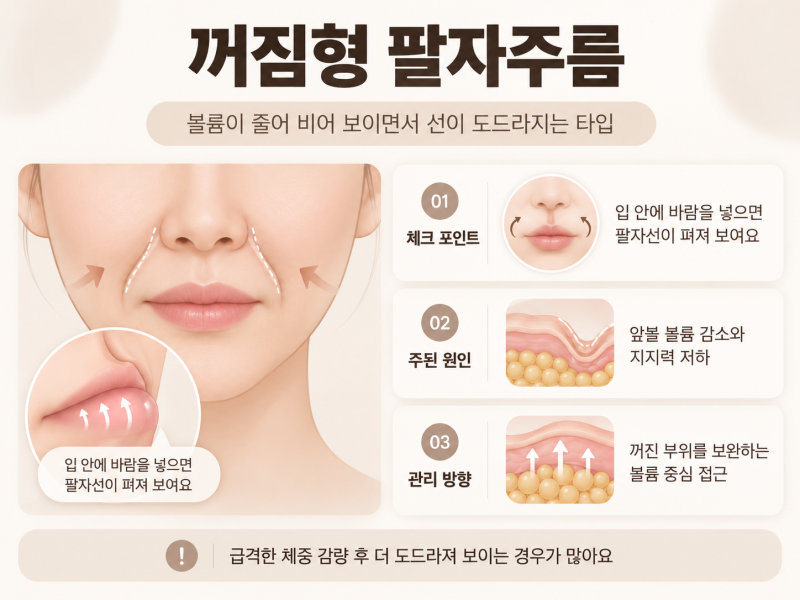
For hollow-type folds, a nasolabial filler that fills
the empty space is usually the first option to consider.
Third, if the line stays the same even after trying both methods,
it's the fine-line type, formed when the same spot has folded
and etched itself in over a long period of time.
Because it looks thin and sharp, as if drawn with a knife,
it's also called a 'knife line,' and
skin booster treatments that help the skin itself recover
are a better fit.
This type often appears in people whose skin texture has thinned overall,
so be sure to keep up consistent moisturizing and sun protection.
That said, this is just a simple check you can do at home,
so for an accurate assessment, it's best to have a professional examination.
So can this line be completely erased?
To be honest, if you aim for complete removal,
you may end up looking unnatural.
As mentioned earlier, this is a normal structure
that everyone has.
So a realistic goal is to refine the line
so that it stands out less
and your overall impression looks noticeably softer.
Sagging, hollowing, and fine lines often coexist on the same face,
so rather than sticking to just one method,
it's important to find the right combination for your facial structure.
Start with small habits, like applying sunscreen thoroughly
and avoiding sleeping only on your more comfortable side. When needed,
consult with your medical team.
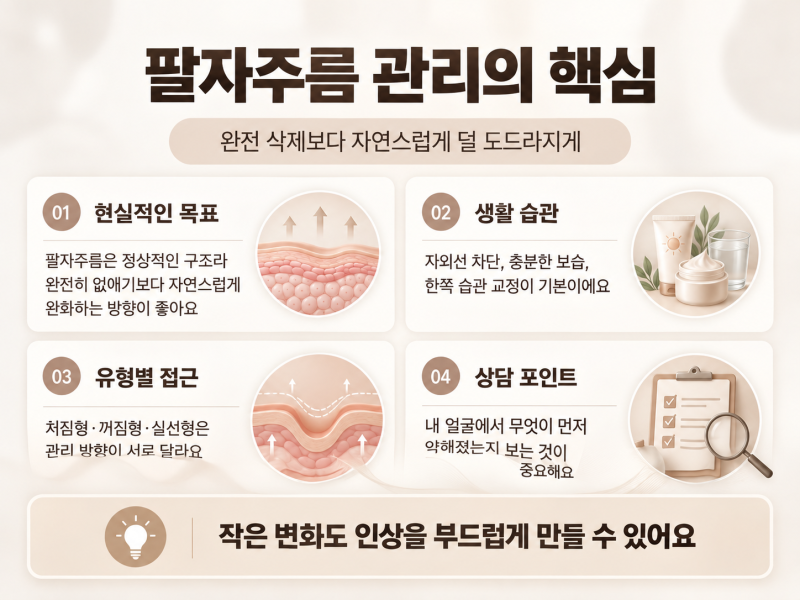
Applying plenty of moisturizer after washing your face before bed,
and drinking water often to keep your skin hydrated from within,
can make a bigger difference than you might think.
Looking down at your phone for long periods can also
cause the lower face to sag, so we recommend
raising the screen to eye level.
Rather than trying to change everything all at once,
caring for your face step by step, at its own pace,
is ultimately what leads to the most natural-looking results.
Small changes you might not expect
can make a big difference in your overall impression.
This post is a medical advertisement written by the clinic for the purpose of providing medical information. It complies with Article 56, Paragraph 1 of the Medical Service Act. Results may vary depending on individual constitution and health condition, so please make treatment decisions after thorough consultation with your medical team.
Frequently Asked Questions
Do nasolabial folds get deeper if you smile a lot?
No, smiling alone does not cause them. The corners of the mouth are constantly moving when you talk, chew, or make facial expressions, so all of that movement gradually takes its toll. In particular, if you often turn down the corners of your mouth or press your lips together tightly as a habit, the same area can be pressed repeatedly.
Why do nasolabial folds form?
This is because, with age, the multiple layers surrounding the line all change together. As collagen and elastic fibers decline, the skin thins, and as the fat in the front of the cheeks decreases, the cushion that supports the line disappears. As the fascia loosens and the bones beside the nose and along the upper jaw recede inward, the supporting base lowers.
Can nasolabial folds be completely erased?
A more realistic goal is to refine the folds so they stand out less, rather than erasing them completely. This line is a natural structure that even newborn babies have, so aiming for complete removal can actually make you look unnatural.
Can I check my nasolabial fold type at home?
Yes, a simple self-check is possible with just a mirror. If the line fades or disappears when you gently lift your cheeks upward, it's closer to the sagging type. If the line smooths out when you puff out your upper lip by holding air inside your mouth, it's closer to the hollow type. If the line stays the same after both tests, it's closer to the fine-line type. For an accurate assessment, however, it's best to have a professional examination.
What habits can make nasolabial folds show earlier?
UV exposure, smoking, and frequent drinking can speed up the skin's aging clock. UV rays damage elastic fibers, while smoking and frequent drinking interfere with collagen production. Habits such as sleeping on one side only, resting your chin on your hand, and chewing only on one side can keep one side of the face creased, which can easily lead to asymmetry.
How should I start managing nasolabial folds?
Start with small, everyday habits. Apply sunscreen thoroughly, use plenty of moisturizer after washing your face before bed, drink water regularly, and raise your phone to eye level. When needed, consult with your medical team.